A bunch of news about Computer vision, Computer Graphics, GPGPU or the mix of the three....
Friday, August 5, 2011
AMD APP KernelAnalyzer 1.9 (OpenCL)
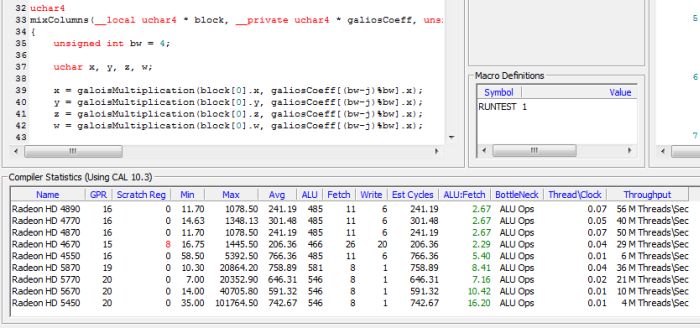
"AMD has published an update of its tool for OpenCL developers. AMD’s APP KernelAnalyzer is a tool to compile, analyze and disassemble OpenCL, Brook+ or IL (Intermediate Language) kernels for Radeon GPUs. APP SDK v2.5 or greater is required for OpenCL support and ATI Stream 1.4 for Brook+.
AMD APP KernelAnalyzer main features
Compile, analyze and disassemble the OpenCL kernel for multiple Catalyst driver versions and GPU device targets.
View any kernel compilation errors and warnings generated by the OpenCL runtime.
View the AMD Intermediate Language (IL) code generated by the OpenCL run-time.
View the ISA code generated by the AMD Shader Compiler.
View various statistics generated by analyzing the ISA code.
View General Purpose Registers and spill registers allocated for the kernel.
Official page and download: APP KernelAnalyzer @ AMD."
Source Geeks3D
Wednesday, June 15, 2011
AMD gDEBugger, an advanced OpenGL and OpenCL debugger
AMD gDEBugger is an advanced OpenGL and OpenCL debugger, profiler and memory analyzer. Actually AMD gDEBugger is based on the well known gDEBugger by Graphic Remedy. This new debugger is a plugin for Visual Studio and supports all capabilities of the original gDEBugger as well as new features.
"gDEBugger takes the mystery out of debugging OpenCL and OpenGL, allowing developers to peer into computer and graphic memory objects such as OpenCL images to view their contents as they change from write, copy, and kernel operations. Allocated OpenCL and OpenGL objects are monitored to allow detecting memory leaks and the scenarios that caused the leaking objects to be created, API function call logs can be viewed and saved and unrecommended and deprecated functions and behaviors are marked, with best-practice alternatives offered. "
AMD gDEBugger download should be available shortly.
More information on the official homepage: AMD gDEBugger @ AMD.
Source : Geeks3D
Wednesday, May 11, 2011
Intel OpenCL 1.1 SDK (beta version)
"Intel has published a new version of its OpenCL SDK. This new SDK, targeting Intel CPUs, supports the OpenCL 1.1 specification and brings a preview support for Linux (64-bit only).
Intel OpenCL SDK version 1.1 new features:
SDK is fully conformant with OpenCL 1.1 specification for the CPU
Beta support for Microsoft* Windows* operating systems (32 and 64 bit)
Preview support for Linux* operating systems
OpenCL Installable Client Driver (ICD) Compliant
Unique Implicit CPU Vectorization Module for best utilization of the CPU hardware vector units (SIMD) across work items
Optional OpenCL 1.1 Core Features: Out-of-order execution model, Execution of native kernels, Image support and Optimization options through OpenCL complier flags (cl-fast-relaxed-math)
Double precision floating point extension (cl_khr_fp64)
OpenGL*/OpenCL Sharing (cl_khr_gl_sharing)
Preview: Device Fission Extension Support (cl_ext_device_fission)
Code samples
Debug and Analyze with the Intel OpenCL SDK Tools: Debug kernels using printf (cl_intel_printf), Intel OpenCL SDK Offline Complier and Code
Analyzer, Intel Graphics Performance Analyzers support, OpenCL kernel analyzing using Intel VTune Amplifier XE 2011 Integration
Detailed release notes are available HERE."
Tuesday, March 29, 2011
AMD OpenCL Emu Documentation
OpenCL Emu is a set of effective tools for the OpenCL software development designed for AMD GPUs
without the explicit need of GPU hardware. It allows developing and debugging an OpenCL kernel as a
C++ procedure inside your MS Visual Studio application while providing an easy switch between CPU,
GPU or GPU-emulator at the backend.
This tool would enable programmers to start developing using OpenCL language instantly without having
to learn the intricacies of the OpenCL run-time, saving them time to concentrate more on developing
parallel algorithms and making the shift to OpenCL a step easier.
Source : http://www.geeks3d.com/forums/index.php/topic,2065.0.html
Monday, March 7, 2011
WebGL final Spec
The latest WebGL 1.0 spec is available HERE.
WebCL is the JavaScript binding to OpenCL, the open computing language. WebCL creates the potential to harness GPU and multi-core CPU parallel processing from a Web browser, enabling significant acceleration of applications such as image and video processing and advanced physics for WebGL games.
Friday, January 28, 2011
Ati Stream becomes AMD Accelerated Parallel Processing (APP) SDK
What is AMD APP Technology?AMD APP technology is a set of advanced hardware and software technologies that enable AMD graphics processing cores (GPU), working in concert with the system’s x86 cores (CPU), to accelerate many applications beyond just graphics. This enables better balanced platforms capable of running demanding computing tasks faster than ever, and sets software developers on the path to optimize for AMD Accelerated Processing Units (APUs).What is the AMD APP Software Development Kit?The AMD APP Software Development Kit (SDK) is a complete development platform created by AMD to allow you to quickly and easily develop applications accelerated by AMD APP technology. The SDK allows you to develop your applications in a high-level language, OpenCL™ (Open Computing Language).What is OpenCL™?OpenCL™ is the first truly open and royalty-free programming standard for general-purpose computations on heterogeneous systems. OpenCL™ allows programmers to preserve their expensive source code investment and easily target both multi-core CPUs and the latest GPUs, such as those from AMD.Developed in an open standards committee with representatives from major industry vendors, OpenCL™ gives users what they have been demanding: a cross-vendor, non-proprietary solution for accelerating their applications on their CPU and GPU cores.To learn more, see the OpenCL Zone.To get the AMD APP SDK with OpenCL Support, download here.
Source : Ozone3D and AMD
Wednesday, January 26, 2011
AMD OpenCL University Kit
http://developer.amd.com/
Students only need basic knowledge of C/C++ programming to understand the materials in this course, and those students with basic knowledge of OpenCL programming can start with Lecture 5.A C/C++ compiler and an OpenCL implementation (such as the AMDAPP SDK)are needed to complete the exercises.
Lecture 1: Introduction to Parallel Computing
Lecture 2: Introduction to OpenCL
Lecture 3: Introduction to OpenCL, continued
Lecture 4: GPU Architecture
Lecture 5: OpenCL Buffers and Complete Examples
Lecture 6: Understanding GPU Memory
Lecture 7: GPU Threads and Scheduling
Lecture 8: Optimizing Performance
Lecture 9: OpenCL Programming and Optimization Case Study
Lecture 10: OpenCL Extensions
Lecture 11: Events Timing and Profiling
Lecture 12: Debugging
Lecture 13: Programming Multiple Devices
Wednesday, November 17, 2010
Intel OpenCL SDK
Friday, August 27, 2010
OpenCL™ Optimization Case Study: Simple Reductions
The article is well explained with illustration to show each clever idea to use the full SMID machine. It explain how to implement parallel Reduction operation on GPU (A reduce operation with a given predicat => find a min, max ...).
| Associative Reduction Tree and SIMD Mapping |
| Commutative Reduction and SIMD Mapping |
| Two-stage Reduction |
__kernel
void reduce(__global float* buffer,
__const int block,
__const int length,
__global float* result) {
int global_index = get_global_id(0) * block;
float accumulator = INFINITY;
int upper_bound = (get_global_id(0) + 1) * block;
if (upper_bound > length) upper_bound = length;
while (global_index < upper_bound) {
float element = buffer[global_index];
accumulator = (accumulator < element) ? accumulator : element;
global_index++;
}
result[get_group_id(0)] = accumulator;
}
Source : AMD
Monday, November 16, 2009
CUDA Toolkit 3.0 beta released, now with public downloads
Nvidia have released to public the CUDA Toolkit 3.0.
I will not list all the Highlight.... they list because is too long.
But the most important point (related to image processing and OpenGL application are the following points) Support for all the OpenCL features in the latest R195.39 beta driver:
Double Precision
OpenGL Interoperability, for interactive high performance visualization
OpenCL Images support, for better/faster image filtering
32-bit Atomics for fast, convenient data manipulation
Byte Addressable Stores, for faster video/image processing and compression algorithms
Support for the latest OpenCL spec revision 48 and latest official Khronos OpenCL headers as of 11/1/2009
OpenCL Tutorials
AMD/ATI have a great page related to his "ATI Stream" tech. You can have access to "Developer Articles & Publications.
Notice that you have two tutorial on OPENCL.
I'm quite impatient to test OpenCL for real.