Google launch a service to perform web image search by similarity. It's a service like http://www.tineye.com/.
http://images.google.com/ A camera have appear in the text label. Drag and Drop an image on the text field or click on the camera.
A bunch of news about Computer vision, Computer Graphics, GPGPU or the mix of the three....
Showing posts with label Image processing. Show all posts
Thursday, June 16, 2011
Monday, June 13, 2011
What's new in Computer Vision System Toolbox in R2011a
Matlab have updated is Computer Vision System Toolbox.
Here's the documentation.
Here’s a list of what’s new:
Here's the documentation.
Here’s a list of what’s new:
- extractFeatures function for creating an array of feature vectors (descriptors) based on interest points within an image
- matchFeatures function for finding the best matches between two arrays of feature vectors (descriptors)
- Visualization of epipolar geometry for stereo images using epipolarLine, isEpipoleInImage, and lineToBorderPoints functions
- estimateUncalibratedRectification function for calculating projective transformations to rectify stereo images
- Video segmentation based on Gaussian Mixture Models using ForegroundDetector System object YCbCr video format support for ToVideoDisplay block and DeployableVideoPlayer System object
- vision.BlockMatcher
- vision.Deinterlacer
- vision.GeometricTransformEstimator
- vision.OpticalFlow
- vision.TemplateMatcher
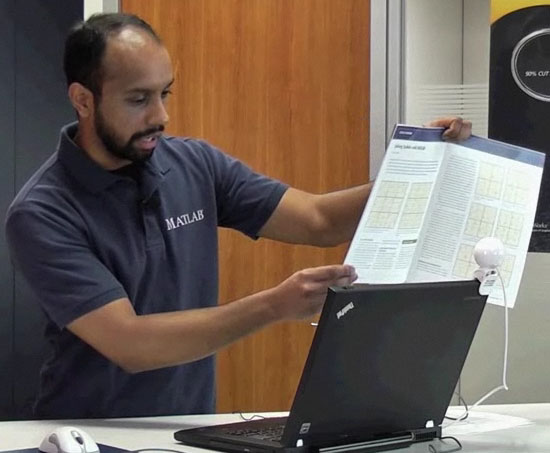
Matlab Visual Sudoku Solver
After the Google Goggles Sudoku Demo Matlab have released near the same demo.
Not purely real time. But a working one with explanation. (Basis bricks are a sudoku solver, some image processing (morphological operations) and number recognition).
http://www.mathworks.com/videos/matlab/sudoku.html
The source code is accessible on the same webpage.
Not purely real time. But a working one with explanation. (Basis bricks are a sudoku solver, some image processing (morphological operations) and number recognition).
http://www.mathworks.com/videos/matlab/sudoku.html
The source code is accessible on the same webpage.
Wednesday, March 23, 2011
Homemade Touch screen
With a few of electronics and captors !!!
A Line CDD, a few LED ... and a program
Libellés :
Image processing,
Multitouch,
Tech demo
Friday, March 11, 2011
Panoramic video acquisition
Giroptic French company purpose a nice tiny box to perform 360°*180° acquisitions up to 30mega pixels.
3 fisheye lenses apparently share one imaging sensor, everything hard-mounted into one device, so you'd have zero alignment issues.
It can shoot panoramic video and take 7000x3000 (= 21 MP) panoramas with HDR bracketing.
3 fisheye lenses apparently share one imaging sensor, everything hard-mounted into one device, so you'd have zero alignment issues.
It can shoot panoramic video and take 7000x3000 (= 21 MP) panoramas with HDR bracketing.
It replaces nicely the old Giroptic camera :
Source : Girocam
Libellés :
Image processing,
Panoramic images,
Tech demo
Friday, February 25, 2011
Maskarad Di-O-Matic
A markerless facial mocap software : It localizes automatically the face and track it.
Libellés :
Computer Graphics,
computer vision,
Image processing,
Tech demo
Wednesday, February 9, 2011
Average face per country
This study show average faces per country...
Quite fun to see :
French :


https://pmsol3.wordpress.com/2009/10/10/world-of-averages-europeave/
https://pmsol3.wordpress.com/2009/10/10/world-of-averages-populations-of-the-americas/
https://pmsol3.wordpress.com/2009/10/10/world-of-averages-africans/
https://pmsol3.wordpress.com/2009/10/10/world-of-facial-averages-middle-eastern-and-central-asian/
https://pmsol3.wordpress.com/2009/10/10/world-of-facial-averages-east-southeast-asia-pacific-islander/
Source : Izismile
Quite fun to see :
French :
https://pmsol3.wordpress.com/2009/10/10/world-of-averages-europeave/
https://pmsol3.wordpress.com/2009/10/10/world-of-averages-populations-of-the-americas/
https://pmsol3.wordpress.com/2009/10/10/world-of-averages-africans/
https://pmsol3.wordpress.com/2009/10/10/world-of-facial-averages-middle-eastern-and-central-asian/
https://pmsol3.wordpress.com/2009/10/10/world-of-facial-averages-east-southeast-asia-pacific-islander/
Source : Izismile
Libellés :
computer vision,
Image processing
Friday, February 4, 2011
C++Inder a C++ library
C++Inder is for the C++ that was Processing is for Java.
CINDER PROVIDES A POWERFUL, INTUITIVE TOOLBOX for programming graphics, audio, video, networking, image processing and computational geometry. Cinder is cross-platform, and in general the exact same code works under Mac OS X, Windows and a growing list of other platforms — most recently the iPhone and iPad.
Cinder is designed to take advantage of platforms’ native capabilities whenever it’s possible, and relies on a minimum of 3rd party libraries. This makes for much lighter, faster applications, and means Cinder apps get free performance, security and capability upgrades whenever the operating system does.
We also have worked hard to create a library that feels familiar and intuitive to C++ programmers, building on the idioms and techniques the C++ community has developed over its long history. Cinder’s modern internal memory management virtually eliminates leaks, not only of memory but also of resources like OpenGL textures. We make use of the exceptional Boost libraries to fill in any gaps, and always favor techniques built on features which are currently or soon will be standard C++ (such as std::thread or std::shared_ptr).
We are proud of Cinder, and while we think you’ll be hard-pressed to find a more powerful environment for creative coding, we’re just getting started. We hope you’ll take the time to experiment with Cinder yourself, and if you like what you see, come join our community.
A example of "demo" application with Kinect :
Hand Tracking from Andrew Berg on Vimeo.
In the same vein you have also TOXICLIBS :
I particularly like this demo :
http://toxiclibs.org/2010/01/re-inventing-the-wheel/
Libellés :
Computer Graphics,
computer vision,
Image processing,
SDK,
Tech demo
Thursday, December 30, 2010
Hany Farid : Fundamentals of Image Processing
This guide from Hany Farid gives you a mathematical viewpoint of common point use in Image Processing.
It's a good introduction.
Learn about the fundamentals of signal and image processing built upon a unifying linear algebraic framework.
http://www.cs.dartmouth.edu/farid/tutorials/fip.pdf
Other short guide are accessible here : http://www.cs.dartmouth.edu/farid/tutorials/
It's a good introduction.
Learn about the fundamentals of signal and image processing built upon a unifying linear algebraic framework.
http://www.cs.dartmouth.edu/farid/tutorials/fip.pdf
Other short guide are accessible here : http://www.cs.dartmouth.edu/farid/tutorials/
Libellés :
Image processing,
Matlab,
tech paper
Tuesday, December 28, 2010
Sixth Sense interface
I really like the concept at 3 minutes by using the white page and a logo as a tracking pattern.
It's like a reverse movement captation (a computer vision gyroscope !).
SixthSense from Fluid Interfaces on Vimeo.
Found here http://vimeo.com/17567999
"'SixthSense' is a wearable gestural interface that augments the physical world around us with digital information and lets us use natural hand gestures to interact with that information. By using a camera and a tiny projector mounted in a pendant like wearable device, 'SixthSense' sees what you see and visually augments any surfaces or objects we are interacting with. It projects information onto surfaces, walls, and physical objects around us, and lets us interact with the projected information through natural hand gestures, arm movements, or our interaction with the object itself. 'SixthSense' attempts to free information from its confines by seamlessly integrating it with reality, and thus making the entire world your computer."
Thursday, December 2, 2010
Omni stereo camera
ViewPlus a Japonese company purpose fun OmniStereo camera :
I let you admire the works and camera placement ! and the three model Jupiter, Saturn and Venus
| this cam get 60 eyes ! |
They are build on a basis component like this one :
If you want to know more : ViewPlus
Libellés :
computer vision,
Image processing,
Tech demo
Saturday, November 13, 2010
Kinect camera Hack !
The Kinect camera is out, and some guyalready hack the DepthMap images to make TechDemo :
XBox Kinect running on OS X ( with source code ) from Theo Watson on Vimeo.
Friday, September 10, 2010
Real-time O(1) Bilateral Filtering
This paper comes from CVRP09
Real-time O(1) Bilateral Filtering
Qingxiong Yang, Kar-Han Tan and Narendra Ahuja, Real-time O(1) Bilateral Filtering, IEEE Conference on Computer Vision and Pattern Recognition (CVPR) 2009. [PDF [Poster | Video Demo1, Video Demo2 | Code (cpu) (at submission) (updated) (updated, with spatial quantization) | ]
Real-time O(1) Bilateral Filtering
We propose a new bilateral filtering algorithm with computational complexity invariant to filter kernel size, so calledO(1) or constant time in the literature. By showing that a bilateral filter can be decomposed into a number of constant time spatial filters, our method yields a new class of constant time bilateral filters that can have arbitrary spatial1 and arbitrary range kernels. In contrast, the current available constant time algorithm requires the use of specific spatial or specific range kernels. Also, our algorithml ends itself to a parallel implementation leading to the first real-time O(1) algorithm that we know of. Meanwhile, our algorithm yields higher quality results since we are effectively quantizing the range function instead of quantizing both the range function and the input image. Empirical experiments show that our algorithm not only gives higher PSNR, but is about 10× faster than the state-of-the-art. It also has a small memory footprint, needed only 2% of the memory required by the state-of-the-art for obtaining thes ame quality as exact using 8-bit images. We also show that our algorithm can be easily extended for O(1) median filtering. Our bilateral filtering algorithm was tested in a number of applications, including HD video conferencing,video abstraction, highlight removal, and multi-focus imaging.
Libellés :
computer vision,
Image processing,
Tech demo
Thursday, September 9, 2010
Try glasses with Augmented Reality
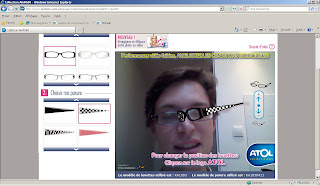
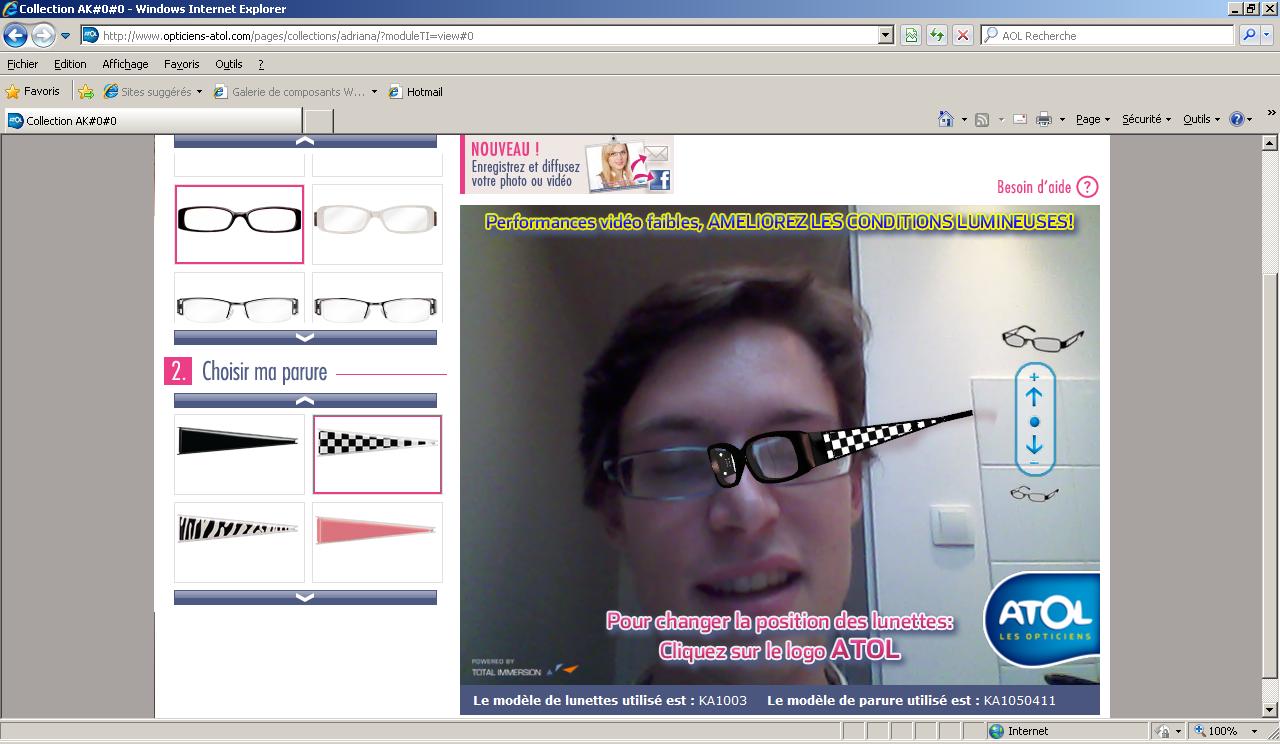
"Atol unveiled a new web-based experience offering people to try latest glasses collection “AK Adriana Karembeu”. This augmented reality experience uses Total Immersion D’Fusion@Home and face tracking technology."
The only major problem of such things is that people that need glasses to see things... could not see their head clearly (so it's fashion application product)... An augmented reality that could delete your old glasses and replace them by a new model could be really cool and useful.
The demo works fine, but the soft could loose the head tracking and so cumulate error and do not be able to set the glasses to the good position over your head. The rendering look a little bit plastic, but the soft could not estimate a environment map by using only the face...
| Here we could see that the tracking is lost ! |
Source : here and here
Libellés :
Computer Graphics,
computer vision,
Image processing,
Tech demo
Tuesday, September 7, 2010
Geometric Computer Vision courses
Here a course on geometric computer vision from Dr Marc Pollefeys
Course Objectives
After attending this course students should:
Understand the concepts that allow recovering 3D shape from images.
Have a good overview of the state of the art in geometric computer vision.
Be able to critically analyze and asses current research in the area
Implement components of a 3D photography system.
Course Topics
The course will cover the following topics a.o. camera model and calibration, single-view metrology, triangulation, epipolar and multi-view geometry, two-view and multi-view stereo, structured-light, feature tracking and matching, structure-from-motion, shape-from-silhouettes and 3D modeling and applications.
Target Audience
The target audience of this course are Master or PhD students, or advanced Bachelor students, that are interested in learning about geometric computer vision and related topics.
Libellés :
Computer Graphics,
computer vision,
Image processing,
Photography
Panorama Tracking and Mapping on Mobile Phones
For the tech side :
http://studierstube.icg.tu-graz.ac.at/handheld_ar/naturalfeature.php
Related paper :
Real-time Panoramic Mapping and Tracking on Mobile Phones
Online Creation of Panoramic Augmented Reality Annotations on Mobile Phones
Authors: Tobias Langlotz, Daniel Wagner, Alessandro Mulloni, Dieter Schmalstieg
Details:Accepted for IEEE Pervasive Computing
We present a novel approach for creating and exploring annotations in place using mobile phones. The system can be used in large-scale indoor and outdoor scenarios and offers an accurate mapping of the annotations to physical objects. The system uses a drift-free orientation tracking based on panoramic images, which can be initialized using data from a GPS sensor. Given the current position and view direction, we show how annotations can be accurately mapped to the correct objects, even in the case of varying user positions. Possible applications range from Augmented Reality browsers to pedestrian navigation.
Libellés :
Computer Graphics,
computer vision,
Image processing,
Panoramic images,
Tech demo
Thursday, September 2, 2010
Kmeans a tutorial
Here you will find a short tutorial of the process of the KMean algorithm.
K-Means is a clustering algorithm. That means you can “group” points based on their neighbourhood. When a lot of points a near by, you mark them as one cluster. With K-means, you can find good center points for these clusters.
Libellés :
Computer Graphics,
computer vision,
Image processing,
Tech demo
SIFT an illustrated tutorial
On the web we found a bunch of things... and sometimes interesting things.
Here a point per point study of the SIFT process. (I'm not agree with all the illustration, but the idea is here and could help people to understand the meaning of each process).
1. Constructing a scale space
2. LoG Approximation
3. Finding keypoints
4. Get rid of bad key points
5. Assigning an orientation to the keypoints
6. Generate SIFT features
| http://www.aishack.in/2010/05/sift-scale-invariant-feature-transform/ |
Here a point per point study of the SIFT process. (I'm not agree with all the illustration, but the idea is here and could help people to understand the meaning of each process).
1. Constructing a scale space
2. LoG Approximation
3. Finding keypoints
4. Get rid of bad key points
5. Assigning an orientation to the keypoints
6. Generate SIFT features
Libellés :
computer vision,
Image processing,
Tech demo
Wednesday, September 1, 2010
Popcode AR for mobile phone
"Popcode is what is known in the trade as a Markerless Augmented Reality platform. That means you can add additional content onto any image (providing it has enough texture). You do not need to print large black-and-white markers to be able to add Augmented Reality (AR) content to the world using Popcode." The product was realized by Extra Reality Ltd.
For the tech side :
The founder are Simon Taylor, Dr. Tom Drummond (The thesis supervisor of Simon) and Connell Gauld (Mobile platform coder expert).
=> They used Fast corder detector, HIPS matching.
I let you see the SDK !
And the demos :
Tuesday, August 31, 2010
CUDA-Surf
In computer vision we always want something fast... This implementation of SURF rely on CUDA on so work on GPU.
We do not have any information about the timings...
http://www.mis.tu-darmstadt.de/surf
We do not have any information about the timings...
http://www.mis.tu-darmstadt.de/surf
Libellés :
computer vision,
GPGPU,
Image processing,
Tech demo
Subscribe to:
Posts (Atom)