Lytro have added the perspective change thanks to the lightField acquisition:
http://techcrunch.com/2012/11/15/lytro-reinvents-the-camera-once-again-now-lets-photos-change-perspective-along-with-focus/
Small ideas for a big world
A bunch of news about Computer vision, Computer Graphics, GPGPU or the mix of the three....
Tuesday, November 20, 2012
Friday, June 15, 2012
Markdow preview
Markdown is a lightweight markup language, It is supported by default on GitHub to have lightweight nice description. Here a tool in order to preview in real time your writtings !
http://github.github.com/github-flavored-markdown/preview.html
Windows guys could try the excellent: http://markdownpad.com/

Thursday, June 7, 2012
SoftKinetic
Belgian Middleware company Softkinetic has developed a complete camera-based motion interface solution for Atom-based set-top-boxes and PCs.
Monday, June 4, 2012
Wednesday, February 8, 2012
Webcam realtime Sudoku solver
A nice article about merging Image processing and a real time issue (visual sudoku solver)
http://www.codeproject.com/Articles/238114/Realtime-Webcam-Sudoku-Solver
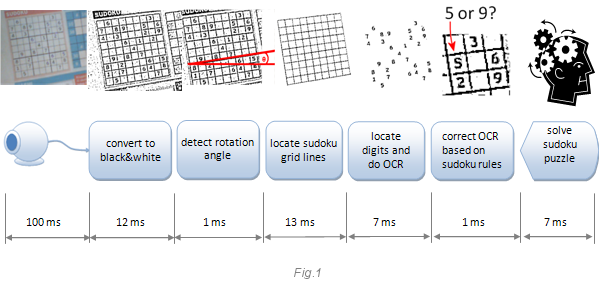
It reminds me the Martin Byröd approach
Martin Byröd,
[An Optical Sudoku Solver],
SSBA, Linköping, 2007.
Monday, January 23, 2012
Monday, December 19, 2011
Particle Swarm Optimisation and Genetic Algorithm
"Particle Swarm Optimization (PSO) is a relatively recent heuristic search method whose
mechanics are inspired by the swarming or collaborative behavior of biological populations.
PSO is similar to the Genetic Algorithm (GA) in the sense that these two evolutionary
heuristics are population-based search methods. In other words, PSO and the GA move
from a set of points (population) to another set of points in a single iteration with likely
improvement using a combination of deterministic and probabilistic rules. The GA and its
many versions have been popular in academia and the industry mainly because of its
intuitiveness, ease of implementation, and the ability to effectively solve highly nonlinear,
mixed integer optimization problems that are typical of complex engineering systems. The
drawback of the GA is its expensive computational cost." queted from "A COMPARISON OF PARTICLE SWARM OPTIMIZATION AND THE GENETIC ALGORITHM"
_____
The pseudo code of PSO procedure is as follows
For each particle
Initialize particle
END
Do
For each particle
Calculate fitness value
If the fitness value is better than the best fitness value (pBest) in history
set current value as the new pBest
End
Choose the particle with the best fitness value of all the particles as the gBest
For each particle
Calculate particle velocity according equation (a)
Update particle position according equation (b)
End
While maximum iterations or minimum error criteria is not attained
_____
Most of evolutionary techniques have the following procedure:
1. Random generation of an initial population
2. Evaluate the fitness value for each subject.
3. Reproduction of the population based on fitness values, add random solution to explore the space of solution.
4. If requirements are met, then stop. Otherwise go back to 2.
_____
Using evolutionary algorithm or PSO are nice formulation for some complex problem but visualizing the evolutionary process is fun.
You could take a look to : Yong-Hyuk Kim, Kang Hoon Lee and Yourim Yoon, Visualizing the Search Process of Particle Swarm Optimization, Proceedings of the 11th Annual conference on Genetic and evolutionary computation (GECCO 2009), 49-56, July 2009. (videos)
If you want play:
PSO: http://code.google.com/p/particle-swarm-optimization/
Genetic Algorithm: Evolving Objects (EO): an Evolutionary Computation Framework
mechanics are inspired by the swarming or collaborative behavior of biological populations.
PSO is similar to the Genetic Algorithm (GA) in the sense that these two evolutionary
heuristics are population-based search methods. In other words, PSO and the GA move
from a set of points (population) to another set of points in a single iteration with likely
improvement using a combination of deterministic and probabilistic rules. The GA and its
many versions have been popular in academia and the industry mainly because of its
intuitiveness, ease of implementation, and the ability to effectively solve highly nonlinear,
mixed integer optimization problems that are typical of complex engineering systems. The
drawback of the GA is its expensive computational cost." queted from "A COMPARISON OF PARTICLE SWARM OPTIMIZATION AND THE GENETIC ALGORITHM"
_____
The pseudo code of PSO procedure is as follows
For each particle
Initialize particle
END
Do
For each particle
Calculate fitness value
If the fitness value is better than the best fitness value (pBest) in history
set current value as the new pBest
End
Choose the particle with the best fitness value of all the particles as the gBest
For each particle
Calculate particle velocity according equation (a)
Update particle position according equation (b)
End
While maximum iterations or minimum error criteria is not attained
_____
Most of evolutionary techniques have the following procedure:
1. Random generation of an initial population
2. Evaluate the fitness value for each subject.
3. Reproduction of the population based on fitness values, add random solution to explore the space of solution.
4. If requirements are met, then stop. Otherwise go back to 2.
_____
Using evolutionary algorithm or PSO are nice formulation for some complex problem but visualizing the evolutionary process is fun.
You could take a look to : Yong-Hyuk Kim, Kang Hoon Lee and Yourim Yoon, Visualizing the Search Process of Particle Swarm Optimization, Proceedings of the 11th Annual conference on Genetic and evolutionary computation (GECCO 2009), 49-56, July 2009. (videos)
If you want play:
PSO: http://code.google.com/p/particle-swarm-optimization/
Genetic Algorithm: Evolving Objects (EO): an Evolutionary Computation Framework
Subscribe to:
Posts (Atom)

